Showing posts with label wellness. Show all posts

Friday, October 14, 2022

a guide to starting a skin care routine in your 30s


your 30s are arguably some of the best years of your life. you’re strong, healthy and you probably have more money than you ever did in your 20s. this is the decade where you feel like you’re finally hitting your stride. you’ve got everything figured out - except for your skin care routine. a solid skin care regimen in your 30s is key to preserving your good looks well into the next decade. here’s how you can start. 
1. swap your soap for a daily facial cleanser if you’re still using regular bar soap to clean your face, it’s time to rethink your daily cleansing habits. bar soaps often have high ph values that can mess with your skin and cause a slew of problems such as acne and dry skin. we recommend saying goodbye to your bar soap and using a daily face wash for men that’s formulated for your skin. a facial cleanser is designed for your face and will wash away dirt, grime and oil without over-drying your skin.
2. moisturise to hydrate and protect your skin moisturising is an essential part of any guy’s skin care routine, regardless of his age or skin type. a good moisturiser will lock in hydration and keep your thirtysomething-year-old skin looking youthful. when shopping for a men’s moisturiser, be sure to find one with spf. according to a 2013 study published in clinical, cosmetic and investigational dermatology, roughly 80 percent of visible facial ageing can be contributed to the sun’s ultraviolet rays. in other words, the sun is ageing your face like no other. by applying a daily moisturiser with spf to your face, you can protect your skin from harmful uv rays and keep wrinkles at bay for longer.
3. give dull skin a good scrub face scrubs are another essential component in your skin care arsenal. a gentle face scrub will help slough off dead skin cells that can build up and cause dull, lifeless-looking skin that often plagues guys in their 30s and beyond. the key to using a face scrub properly is to limit its use to once or twice a week. using your face scrub any more than this can potentially dry out the skin. in your 30s, your skin is still doing a decent job at shedding dead skin cells on its own. even so, it doesn’t hurt to use a face scrub to boost the process along and breathe new life into dull-looking skin.
4. make eye cream part of your routine whether happy hour went on later than expected or you just had a late night, a lack of sleep can show up on your face. those under-eye bags that make you look perpetually tired aren’t a good look and can potentially have serious consequences for your career. don’t believe your skin could be hurting your career? age bias in the workforce has been well-documented. according to a 2015 study published in the british journal of management, researchers suggest that older-looking candidates are less likely to be hired than their younger counterparts because old age is associated with lower health and fitness. adding an eye cream for men to your skin care routine is a small step that can quite literally pay off. in any case, you’ll be much happier waking up in the morning without seeing unsightly eye bags in the mirror.
5. be proactive about wrinkles some guys don’t get wrinkles until their 40s, while others start noticing them in their mid-20s. no matter how many wrinkles you have, now is the time to start thinking about an anti-ageing skin care routine. an anti-ageing skin care regimen doesn’t need to be complicated. if you’re already using eye cream, consider adding a face serum for men to your skin care arsenal. face serums are essentially lightweight moisturisers that are packed with anti-ageing ingredients such as peptides, antioxidants, retinol and ceramides. this high concentration of active ingredients provides a potent, anti-ageing blast to the face that can help reduce fine lines and wrinkles.
6. use sunscreen daily while you may not spend as much time outside as you did in your 20s, protecting your skin from uv rays should still be a top priority. skin cancer can develop at any age. in fact, it’s one of the most common cancers to strike young adults, according to the american cancer society. using sunscreen has been proven, time and again, to significantly reduce the risk of developing skin cancer. by applying sunscreen to your body every day and using your daily moisturiser with spf on your face, you can prevent sunburns and lower your risk of skin cancer in the process.
7. indulge yourself with a men’s facial why wait until your skin is old and wrinkly before giving it the vip treatment? your 30s are the perfect time to start scheduling regular appointments with an esthetician and reaping the benefits of a facial treatment. while getting a men’s facial might seem strange at first, the benefits speak for themselves. facials can be tailored exclusively to your skin’s unique needs and help solve a variety of skin care woes, from acne blemishes to dull skin and wrinkles. with many anti wrinkle injection clinics offering facials, getting rid of wrinkles has never been easier. not to mention that facials come with a sneaky side benefit: total relaxation. with their warm towels and gentle facial massaging, you’ll soon feel your worries start slipping away. you’re basically getting a two-for-one deal.
it’s commonly believed that a man in his 30s is in his prime years. however, you can easily stretch these years into the following decade with the right skin care routine. with a few anti-ageing skin care products, proper sun protection and consistency, you can achieve better skin now and in the future.

Thursday, October 13, 2022

The Effortless Man’s Guide to Basic Skin Care


Minimalist tips for any man looking to invest in self-care


If you’ve been skipping out on skin care, it’s time to talk. You don’t need to do much to repair, protect, and even pamper your mug. We’re recommending the most basic adjustments for long-lasting results. Come learn how to combat breakouts, shaving irritations, and those fine lines that’ll creep out of nowhere. 

Plus, a little shine on the outside treats the inside, too. 

Here’s how to get started — or how to brush up your game, because there’s always something new to help buff up your glow. 

A simple skin care regimen


As with anything we do and expect results, skin care requires consistency. But developing a routine can seem daunting if you don’t know what to do or use. 


1. Cleanse

One thing dudes have gotten right is not washing their face every single morning. This is because washing too much can ruin your skin’s natural oils. 

But this only works if you wash every night. We start each day with a clean slate, so why not let your skin end on a fresh note, too? Don’t let dirt and pollution soak into your pores overnight. 

Kwan recommends using a mild foaming cleanser before you shave to help reduce surface oil. As long as you don’t have sensitive skin, you can alternate between an exfoliating cleanser for an enhanced shaving experience and a mild wash. 

Pro tip: If you have oily skin, you can use a hot towel to clean your face in the morning. Splash with cold water for a refreshing boost.

2. Repair

Our skin takes a beating over time, thanks to free radicals causing oxidative stress. Without going into a chemistry lesson, oxidative stress relates to our bodies’ negative reaction to bad things like:

  • air pollution 
  • cigarette smoke
  • industrial chemicals 
  • UV rays

“An antioxidant serum, for example, like vitamin C, is helpful to reduce damage and should go on in the morning underneath moisturizer,” Kwan says. 

Apply after your shaving routine. 

Pro tip: Before bedtime, Kwan recommends a retinol cream for those in their 30s and up. “Retinol helps smooth fine lines and wrinkles,” he explains. 


3. Moisturize and protect

In the a.m., follow up your antioxidant serum with a moisturizer that has at least SPF 30. Sunscreen isn’t just for the beach or outdoor sports. Incidental sun exposure, like the time you spend walking to the train or sipping a beer on the patio after work, adds up and causes skin damage. 

At night, opt for a lightweight moisturizer without sunscreen. 

Pro tip: You don’t have to moisturize at night if your skin isn’t dry! Moisturizing is a lot like drinking water. Do it when you need it.


How to pick products


From luxury beard oils to tasty, pocket-friendly lip balms, more products have hit shelves with men in mind. Now the dude-specific skin care industry has been more on-point than ever. Which is great — but the influx might also leave you feeling at a loss for what to buy. 

Here are a few things to consider. 

1. Know your skin type

“Men tend to have oily and thicker skin, mainly due to the effects of testosterone,” Kwan says. Many products for fellas will be formulated to combat oil. But if you have flaky, dry skin, seek out products that address that. For dry skin, Kwan recommends a cream cleanser and a heavy moisturizer. 

You may also have a mix of oily and dry patches. If so, look for products formulated for combination skin. And if you have sensitive skin, you may be prone to burning, stinging or irritation. Choose products listing as few ingredients as possible. 


Pro tip: Try “cocktail moisturizing.” This isn’t a fuss-free way to do skin care, but it can be game-changing for combination skin. Instead of using an “all-in-one” moisturizer, try tackling your individual skin concerns with targeted products.

Products to try.


2. Forget gender

“Men-specific products are nice, but many skin care products are unisex and typically are suitable for men and women,” Kwan says. 

Don’t limit yourself to skin care lines based on packaging. If you’re hoping to avoid scents, look for fragrance-free products. Or opt for items with earthy or woodsy essential oils, like sandalwood or cedarwood. These can also have a calming effect.


3. Consider your ethnicity

Your heritage may affect your skin type and skin care needs. “African-American men tend to have more ingrown hairs, usually related to the natural curl of the hair,” says Kwan, a specialist in ethnic skin. “For these men, I often recommend using a depilatory instead of shaving to reduce razor bumps.” 

“Asian and Hispanic men are more prone to irregular skin pigmentation,” he continues, “so they should be careful of sun exposure and perhaps add a skin-brightening product to their regimen.”

Products to try: 


4. Experiment

“Choosing skin care is often as easy as trial and error,” Kwan says. “If possible, buy products from a store that allows returns, or start with samples.” 

If you’re still at a loss for what to put in your medicine cabinet, one way to play around with products is to order a subscription or sample box that sends you a selection of travel sizes based on your preferences. 


Managing skin irritation and eruptions


Bumpy textures are usually the biggest concern guys face when it comes to skin care, Kwan says. He often treats men for razor burn, ingrown hairs, or pimples. 

Shaving is one of the most common

 causes of irritation, but a proper skin care routine in conjunction with shaving can improve skin.

“Start with something simple, like a salicylic acid or benzoyl peroxide wash in the shower daily,” says Kwan. This type of cleanser will help treat most bumps, like folliculitis, ingrown hairs, and acne. “I do recommend electric razors if you get ingrowns or too irritated from shaving. They tend to be a bit easier on the skin.”

Tuesday, October 11, 2022


Skin care: 5 tips for healthy skin

Good skin care — including sun protection and gentle cleansing — can keep your skin healthy and glowing.


Don't have time for intensive skin care? You can still pamper yourself by acing the basics. Good skin care and healthy lifestyle choices can help delay natural aging and prevent various skin problems. Get started with these five no-nonsense tips.

1. Protect yourself from the sun

One of the most important ways to take care of your skin is to protect it from the sun. A lifetime of sun exposure can cause wrinkles, age spots and other skin problems — as well as increase the risk of skin cancer.

For the most complete sun protection:

  • Use sunscreen. Use a broad-spectrum sunscreen with an SPF of at least 15. Apply sunscreen generously, and reapply every two hours — or more often if you're swimming or perspiring.
  • Seek shade. Avoid the sun between 10 a.m. and 4 p.m., when the sun's rays are strongest.
  • Wear protective clothing. Cover your skin with tightly woven long-sleeved shirts, long pants and wide-brimmed hats. Also consider laundry additives, which give clothing an additional layer of ultraviolet protection for a certain number of washings, or special sun-protective clothing — which is specifically designed to block ultraviolet rays.

2. Don't smoke

Smoking makes your skin look older and contributes to wrinkles. Smoking narrows the tiny blood vessels in the outermost layers of skin, which decreases blood flow and makes skin paler. This also depletes the skin of oxygen and nutrients that are important to skin health.

Smoking also damages collagen and elastin — the fibers that give your skin strength and elasticity. In addition, the repetitive facial expressions you make when smoking — such as pursing your lips when inhaling and squinting your eyes to keep out smoke — can contribute to wrinkles.

In addition, smoking increases your risk of squamous cell skin cancer. If you smoke, the best way to protect your skin is to quit. Ask your doctor for tips or treatments to help you stop smoking.

3. Treat your skin gently

Daily cleansing and shaving can take a toll on your skin. To keep it gentle:

  • Limit bath time. Hot water and long showers or baths remove oils from your skin. Limit your bath or shower time, and use warm — rather than hot — water.
  • Avoid strong soaps. Strong soaps and detergents can strip oil from your skin. Instead, choose mild cleansers.
  • Shave carefully. To protect and lubricate your skin, apply shaving cream, lotion or gel before shaving. For the closest shave, use a clean, sharp razor. Shave in the direction the hair grows, not against it.
  • Pat dry. After washing or bathing, gently pat or blot your skin dry with a towel so that some moisture remains on your skin.
  • Moisturize dry skin. If your skin is dry, use a moisturizer that fits your skin type. For daily use, consider a moisturizer that contains SPF.

4. Eat a healthy diet

A healthy diet can help you look and feel your best. Eat plenty of fruits, vegetables, whole grains and lean proteins. The association between diet and acne isn't clear — but some research suggests that a diet rich in fish oil or fish oil supplements and low in unhealthy fats and processed or refined carbohydrates might promote younger looking skin. Drinking plenty of water helps keep your skin hydrated.

5. Manage stress

Uncontrolled stress can make your skin more sensitive and trigger acne breakouts and other skin problems. To encourage healthy skin — and a healthy state of mind — take steps to manage your stress. Get enough sleep, set reasonable limits, scale back your to-do list and make time to do the things you enjoy. The results might be more dramatic than you expect.


Friday, January 4, 2019

How healthy is meditation / yoga for your body ?

The goal of meditation isn't to control your thoughts, its to stop letting them control you.


What is meditation / yoga? 

Meditation is a practice where one uses a technique such as their mind, body and soul, to attract a clear state of mind and feel refreshed. This is for the mind to be as clear as a sky can be. Yoga is also a practice where you learn how to control your breathing and ascetic discipline.


Benefits of yoga 

The relaxation techniques help with a lot in your body such as 
  • Lower back pain
  • headaches
  • arthritis 
  • carpal tunnel syndrome
Last but not least will reduce insomnia and lower blood pressure, for those of you that do have it high up there. 


Benefits of meditation

These specific practices you do while meditating helps with many different things that you might have going on such as 
  • stress
  • compassion 
  • sleepless nights
  • not enough focus
  • very moody
 
If you have any of these, I would highly recommend to start some yoga classes and then let us know how it went and what has improved. 


 Health and Beauty tips

Liz Skincare 

2200 SW 16 ST Suite 224 Miami, FL 33145

Please “like” & share! Thank you!

I hope you’ve found some of my tips helpful!

FOR LIVE ACTION, FOLLOW ME ON SNAPCHAT: lizskincare

BEST SKINCARE WISHES LIZ SKINCARE


Friday, August 17, 2018

Here's how a Colon cleansing can help your skin...

What is a Colon Cleansing? 


A colon cleanse is the process of internally cleansing your intestines (bowels) by alleviating bowel discomfort, aiding the peristaltic functions, softening stool, and overall assisting in more frequent and comfortable bowel movements. Cleansing methods range from natural herbal formulas and careful, restrictive dieting, to enemas, hydrotherapy, colonoscopy, or other methods.
Some people cleanse to “help out” their bowels from consuming junk food.

Others, as you might, do it to figure out how to achieve healthier skin.


Benefits of a Colon Cleanse for Skin


The benefits of a colon cleanse for your skin are sundry. From the way your skin looks to the way your skin feels, a colon cleanse can tackle almost every facet of healthy skin.

Remember: the skin is just the tip of the benefits iceberg of colon cleanses.

  • Colon cleanses can help reduce acne and blemishes.

While many people assume eating “junk food”–like fast-food burgers, french fries, and chips–contributes to acne, that’s not entirely true.
What is harmful, though, is getting grease on your face, drinking excessive diary products (milk, yoghurt), or consuming too much sugar.

When your body consumes sugar, it can spike your body’s blood sugar.


  • Colon cleanses can help relieve inflammation.


When your intestinal functions are not playing at their A game, your body can shoot back with vengeance at your skin, and cause unsightly inflammation.

For example, some people unfortunately suffer from Irritable Bowel Syndrome (IBS). Because of an imbalance in their digestive track, they can experience a host of skin ailments, such as “metastatic lesions, reactive processes to the intestinal inflammation,” and other side effects.


The body then reacts to your body’s intestinal imbalance between the “mucosal epithelium, intestinal microbes, and host immune response“). The antigens between the bowel bacteria and skin don’t agree, essentially, and your skin may react negatively.


  • Colon cleanses can help heal your skin.


Have you heard of “gut flora”? If you haven’t, I’m surprised. It’s been a hot topic since people have been hopping on the trend of probiotics.
Your gut is a microcosm of bacteria responsible for maintaining a healthy pH balance in your digestive tract.


  • Colon cleanses can help overall physical health.


Your physical health is something to be enshrined. You don’t want to be sluggish, debilitated, or unable to do anything as you age.
 By helping your intestines more efficiently eliminate the waste that gets built-up in your bowels, you’re doing your entire body a favor.

And it’s not just your skin or your colon that benefits from a colon cleanse: it’s your entire body.

  • For example, when people eat too much sugar and acquire Diabetes Type II, they suddenly have a higher chance of colon cancer.
While natural colon cleanses neither prevent nor treat colon cancer, it does demonstrate that your body needs all of your organs to function as best as they can; and when you allow your colon to be built up with junk, you risk your entire body’s health.


  • SOURCES

https://www.dermcoll.edu.au/atoz/skin-structure-function/
https://www.webmd.com/skin-problems-and-treatments/features/acne-foods#1
https://www.rush.edu/health-wellness/discover-health/eating-healthy-colon
https://www.ncbi.nlm.nih.gov/pmc/articles/PMC3273725/
https://www.ncbi.nlm.nih.gov/pmc/articles/PMC2731177/
https://www.ncbi.nlm.nih.gov/pmc/articles/PMC3645662/


Health and Beauty tips
2200 SW 16 ST Suite 224 Miami, FL 33145
Please “like” & share! Thank you!
I hope you’ve found some of my tips helpful!
FOR LIVE ACTION, FOLLOW ME ON SNAPCHAT: lizskincare
BEST SKINCARE WISHES LIZ SKINCARE


Wednesday, January 17, 2018

Dull and Tired Skin

Dull, Tired and Stressed skin. 

Imaging a veil over the skin, covering all complexion glows. Skin looks tired strained and no bounce in its step. Skin has overexposed itself and is being scavenged by extrinsic aging. People of all ages complain about a lack of energy. And it’s no wonder. We work long hours making it difficult to manage a personal life, are sleep deprived, and don’t have time to exercise, all while living in a polluted and stress-filled environment. These conditions deplete energy from the body and take their toll our skin too, leaving it dull and lacklustre. To understand the difference between extrinsic and intrinsic aging, look at the backs of your hands. What you see is the result of external, or extrinsic, aging. Now look at the inside of your wrist. The changes you see there are the result of intrinsic aging. 

Symptoms may also include: 
  • Fine lines
  • Coarse wrinkles
  • Loss of elasticity
  • Rough, scaly texture
  • Dry, leathery appearance
  • Broken capillaries
As we grow older, our cells become weaker and signs of damage are more noticeable, we are also constantly exposed to the UV rays of the sun, so our skin starts to appear dry and dull. This is the result of the outside layer of the skin getting excessive build up and is not exfoliated on a regular basis. Build-up is especially noticed after we have spent the summer in the sun. It is more apparent to women since we realise that our make-up doesn't look as fresh and our foundation begins to fade within a couple of hours. Our make-up and foundation is actually being absorbed into the accumulated dead skin cells, which gives a very tired and unhealthy look to the skin. Also as we age everything slows down and vital nutrients are not delivered quickly or well to where they are needed, a good diet is essential. 

Image result for dull and tired skin


Some causes for this could be:

Dryness and lack of proper exfoliation both contribute to skin cell debris.

Exhaustion - Trying to do too much in too little time is taxing both physically and emotionally.
Lack of sleep - For most people, an average of at least eight hours sleep a night is what the body’s immune system needs to fortify itself. Anything less than that and we suffer, whether we’re aware of it or not.
Stress - Our lives are filled with it, both good and bad.
Poor nutrition - When nutrition is good, it enhances body function and maintains steady blood sugar levels throughout the day. When it’s bad, it depletes the system and makes for destructive energy spikes and plunges (which in turn make for not-so-pretty mood swings.)

What you can do to fix that.
  • Invest in a good quality exfoliating scrub that contains fruit acids, glycolic acid or abrasive beads that help slough away the dead cells on the surface of the skin. Dead skin cells don't reflect light well, instead making your skin look dry and dull.
  • Apply an oil-free moisturizer several times daily. Dry skin can often take on a dull, chapped appearance that can make you look tired. Apply moisturizer each day, even if your skin doesn't feel dry. Look for one labeled "noncomedogenic" so you know it won't cause breakouts, even with frequent applications.
  • Wear sunscreen every day. Sun damage can make your skin look discolored and dull, so it's important that a sunscreen with an SPF of 15 or above becomes part of your daily skin care regimen. If adding a sunscreen sounds like too much of a bother, look for a daily moisturizer with a built-in sunscreen to help streamline your morning routine.
  • Wear a tinted moisturizer instead of a thick and heavy foundation. A tinted moisturizer will help your skin's natural color and texture to shine through while adding light reflecting minerals to keep your skin looking bright. Heavy foundations and powders can dull the skin and give it a matte appearance, which can actually make you look older.


Related image


Health and Beauty tips

2200 SW 16 ST Suite 224 Miami, FL 33145
Please “like” & share! Thank you!
I hope you’ve found some of my tips helpful!
FOR LIVE ACTION, FOLLOW ME ON SNAPCHAT: lizskincare 
INSTAGRAM: lizskincaremiami
BEST SKINCARE WISHES LIZ SKINCARE


Monday, December 18, 2017

Skin Cancer the terrible disease

What causes this terrible condition?  Skin cancer is the most prevalent form of all cancers in the U.S. and the number of cases continues to rise. It is the uncontrolled growth of abnormal skin cells. This rapid growth results in tumors, which are either benign (noncancerous) or malignant (cancerous).  

There are three main types of skin cancer: basal cell carcinoma, squamous cell carcinoma and melanoma.Basal cell and squamous cell cancers are less serious types and make up 95% of all skin cancers.Ultraviolet (UV) radiation from the sun is the number one cause of skin cancer, but UV light from tanning beds is just as harmful. Exposure to sunlight during the winter months puts you at the same risk as exposure during the summertime.  

Who is at risk for skin cancer? 

Although anyone can get skin cancer, the risk is greatest for people who have fair or freckled skin that burns easily, light eyes and blond or red hair. Darker skinned individuals are also susceptible to all types of skin cancer, although their risk is substantially lower.Aside from complexion, other risk factors include having a family history or personal history of skin cancer, having an outdoor job and living in a sunny climate. A history of severe sunburns and an abundance of large and irregularly-shaped moles are risk factors unique to melanoma.

Related image

What are the symptoms of skin cancer?

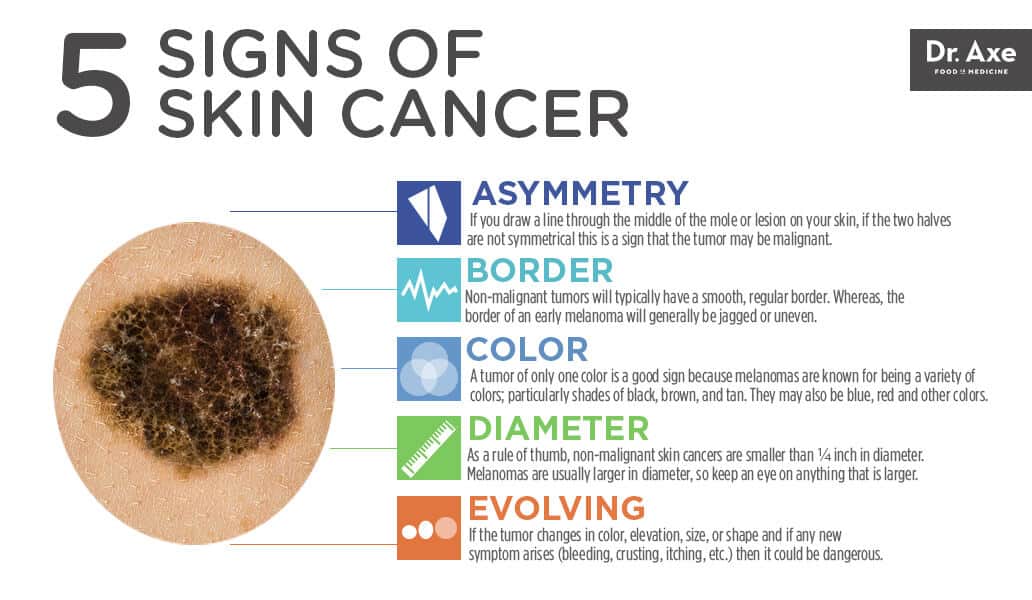
The most common warning sign of skin cancer is a change on the skin, typically a new mole or skin lesion or a change in an existing mole.
  • Basal cell carcinoma may appear as a small, smooth, pearly or waxy bump on the face ears and neck; or as a flat, pink/red- or brown-colored lesion on the trunk or arms and legs.
  • Squamous cell carcinoma can appear as a firm, red nodule, or as a rough, scaly flat lesion that may itch, bleed and become crusty. Both basal cell and squamous cell cancers mainly occur on areas of the skin frequently exposed to the sun, but can occur anywhere.
  • Melanoma usually appears as a pigmented patch or bump. It may resemble a normal mole, but usually has a more irregular appearance.
When looking for melanoma, think of the ABCD rule that tells you the signs to watch for:
  • Asymmetry—the shape of one half doesn't match the other
  • Border—edges are ragged or blurred
  • Color—uneven shades of brown, black, tan, red, white or blue

  • How is skin cancer treated?

Treatment of skin cancer is individualized and is determined by the type of skin cancer, its size and location and the patient's preference.
Standard treatments for non-melanoma skin cancer (basal cell or squamous cell carcinomas) include:
  • Mohs surgery (for high-risk non-melanoma skin cancers)—excision of cancer and some extra tissue
  • Electrodesiccation and curettage—physically scraping away the skin cancer cells followed by electrosurgery
  • Cryosurgery or freezing
  • Laser therapy
  • Drugs (chemotherapy, retinoids)

How can I help prevent skin cancer?


  • Apply sunscreen with a sun protection factor (SPF) of 15 or greater 30 minutes before sun exposure and then every few hours thereafter.
  • Select cosmetic products and contact lenses that offer UV protection.
  • Wear sunglasses with total UV protection.
  • Avoid direct sun exposure as much as possible during peak UV radiation hours between 10:00 a.m. and 3:00 p.m.
  • Perform skin self-exams regularly to become familiar with existing growths and to notice any changes or new growths.
  • Eighty percent of a person's lifetime sun exposure is acquired before age 18. As a parent, be a good role model and foster skin cancer prevention habits in your child.

Related image

Health and Beauty tips


2200 SW 16 ST Suite 224 Miami, FL 33145

Please “like” & share! Thank you!

I hope you’ve found some of my tips helpful!

FOR LIVE ACTION, FOLLOW ME ON SNAPCHAT: lizskincare 
INSTAGRAM: lizskincaremiami

BEST SKINCARE WISHES LIZ SKINCARE


Image Slider