Showing posts with label protect your skin. Show all posts

Tuesday, October 11, 2022


Skin care: 5 tips for healthy skin

Good skin care — including sun protection and gentle cleansing — can keep your skin healthy and glowing.


Don't have time for intensive skin care? You can still pamper yourself by acing the basics. Good skin care and healthy lifestyle choices can help delay natural aging and prevent various skin problems. Get started with these five no-nonsense tips.

1. Protect yourself from the sun

One of the most important ways to take care of your skin is to protect it from the sun. A lifetime of sun exposure can cause wrinkles, age spots and other skin problems — as well as increase the risk of skin cancer.

For the most complete sun protection:

  • Use sunscreen. Use a broad-spectrum sunscreen with an SPF of at least 15. Apply sunscreen generously, and reapply every two hours — or more often if you're swimming or perspiring.
  • Seek shade. Avoid the sun between 10 a.m. and 4 p.m., when the sun's rays are strongest.
  • Wear protective clothing. Cover your skin with tightly woven long-sleeved shirts, long pants and wide-brimmed hats. Also consider laundry additives, which give clothing an additional layer of ultraviolet protection for a certain number of washings, or special sun-protective clothing — which is specifically designed to block ultraviolet rays.

2. Don't smoke

Smoking makes your skin look older and contributes to wrinkles. Smoking narrows the tiny blood vessels in the outermost layers of skin, which decreases blood flow and makes skin paler. This also depletes the skin of oxygen and nutrients that are important to skin health.

Smoking also damages collagen and elastin — the fibers that give your skin strength and elasticity. In addition, the repetitive facial expressions you make when smoking — such as pursing your lips when inhaling and squinting your eyes to keep out smoke — can contribute to wrinkles.

In addition, smoking increases your risk of squamous cell skin cancer. If you smoke, the best way to protect your skin is to quit. Ask your doctor for tips or treatments to help you stop smoking.

3. Treat your skin gently

Daily cleansing and shaving can take a toll on your skin. To keep it gentle:

  • Limit bath time. Hot water and long showers or baths remove oils from your skin. Limit your bath or shower time, and use warm — rather than hot — water.
  • Avoid strong soaps. Strong soaps and detergents can strip oil from your skin. Instead, choose mild cleansers.
  • Shave carefully. To protect and lubricate your skin, apply shaving cream, lotion or gel before shaving. For the closest shave, use a clean, sharp razor. Shave in the direction the hair grows, not against it.
  • Pat dry. After washing or bathing, gently pat or blot your skin dry with a towel so that some moisture remains on your skin.
  • Moisturize dry skin. If your skin is dry, use a moisturizer that fits your skin type. For daily use, consider a moisturizer that contains SPF.

4. Eat a healthy diet

A healthy diet can help you look and feel your best. Eat plenty of fruits, vegetables, whole grains and lean proteins. The association between diet and acne isn't clear — but some research suggests that a diet rich in fish oil or fish oil supplements and low in unhealthy fats and processed or refined carbohydrates might promote younger looking skin. Drinking plenty of water helps keep your skin hydrated.

5. Manage stress

Uncontrolled stress can make your skin more sensitive and trigger acne breakouts and other skin problems. To encourage healthy skin — and a healthy state of mind — take steps to manage your stress. Get enough sleep, set reasonable limits, scale back your to-do list and make time to do the things you enjoy. The results might be more dramatic than you expect.


Wednesday, July 22, 2020

Why to always remove make-up before bed


As a woman I can definitely say that one of the most annoying things to do is having to remove my makeup before bed. You get home exhausted, ready to lay in bed and then that sad moment  of "Omg I still have makeup on" hits you. ALWAYS remove your make up before bed girls or you'll suffer the consequences I will state below!


1. You WILL break out

If you don't cleanse your face, dirt and dead skin cells are not removed and will stay overnight. They stay on the skin, clogging pores and leading to chronic inflammation in the form of pimples.

2. You'll probably look like a zombie the next morning/ or hideous crows feet!

If you've ever woken up in the morning, looked in the mirror, and wished your skin looked brighter, you not removing your makeup the night before you hit bed is most likely the problem. Oils and dead skin cells on the outermost layers of the skin are matted up against the pillow all night, and natural turnover of this dull epidermal layer is diminished. Regular cleansing and exfoliation are necessary to revealing healthy new skin cells and allowing the natural repair processes of the skin to occur and it could cause crows feet!


3. Your skin will look older — and you'll have more wrinkles.

Dirt and makeup trapped against your skin cause environmentally-induced oxidative damage. This leads to a breakdown of the skin barrier and prematurely ages your face.

4. If you have acne, it'll probably might make it worse.

While cleansing is an important step in anyone's beauty regimen, it's especially key for those who have temperamental skin. For those with oily skin, like acne patients, sleeping in makeup could worsen their skin conditions.

5. You could put yourself at risk for an infection.

While you sleeping in your makeup may not cause an infection,  if you already have an active skin issues, such as an inflamed acne pimple, it's possible that an infection can occur because your skin barrier is compromised. 

6. You could develop a rash.

Makeup often contains irritants like dyes and perfumes that, when left on the skin for long periods of time, can cause inflammation especially for those who have sensitive skin.

With 15 + years of experience, this skincare tip is one I mention to my clients often! 


Friday, February 9, 2018

How to Deal with Stretch Marks?


What causes stretch marks?


Stretch marks are a result of skin stretching and an increase of cortisone in your system. Cortisone is a hormone naturally produced by your adrenal glands. However, having too much of this hormone can make your skin lose its elasticity.

Stretch marks are common in certain circumstances:

  • Many women experience stretch marks during pregnancy as the skin stretches in numerous ways to make room for the developing baby. This continual tugging and stretching can cause stretch marks.
  • Stretch marks sometimes appear when you rapidly gain or lose weight. Teenagers may also notice stretch marks after a sudden growth spurt.
  • Corticosteroid creams, lotions, and pills can cause stretch marks by decreasing the skin’s ability to stretch.
  • Cushing's Syndrome, Marfan's Syndrome, Ehlers-Danlo's Syndrome, and other adrenal gland disorders can cause stretch marks by increasing the amount of cortisone in your body.


Who is at risk for developing stretch marks?

  • The following put you at greater risk for developing stretch marks:
  • being a woman
  • being Caucasian (having pale skin)
  • having a family history of stretch marks
  • being pregnant
  • having a history of delivering large babies or twins
  • being overweight
  • having dramatic weight loss or gain
  • using corticosteroid medications.


What can I do to treat stretch marks?

There are many products and procedures that promise to remove stretch marks, but there aren’t any that have proven effective so far. Moisturizing your skin may help to relieve the itchiness of stretch marks. Applying self-tanning lotion to your stretch marks is a temporary way to minimize the difference in color between your normal skin and your stretch marks.


How can I prevent stretch marks?


There’s no way to prevent stretch marks completely, even if you regularly use lotions and creams. However, keeping your weight in a healthy range by eating well and exercising regularly can help to prevent stretch marks caused by sudden weight gain or loss.

While it’s healthy for you and your baby to gain weight when you’re pregnant, ask your doctor how much weight gain during pregnancy is right for you.


What medical treatments are available for stretch marks?

Stretch marks often fade with time. If you don’t want to wait, there are treatments that can improve their appearance. However, no treatment can make stretch marks disappear completely.
There are several ways to improve the appearance of stretch marks:
  • Tretinoin Cream (Retin-A, Renova) works by restoring collagen, a fibrous protein that helps give your skin elasticity. It’s best to use this cream on recent stretch marks that are red or pink. This cream may cause skin irritation. If you’re pregnant, you shouldn’t use tretinoin cream.
  • Pulsed dye laser therapy encourages the growth of collagen and elastin. It’s best to use this therapy on newer stretch marks. Darker-skinned individuals may experience skin discoloration.
  • Fractional photothermolysis is similar to pulsed dye laser therapy in that it uses a laser. However, it works by targeting smaller areas of your skin, causing less skin damage.
  • Microdermabrasion involves polishing the skin with tiny crystals to reveal new skin that’s under the more elastic stretch marks. Microdermabrasion can improve the appearance of older stretch marks.
  • The excimer laser stimulates skin color (melanin) production so that stretch marks match the surrounding skin more closely.

Medical procedures and prescription medicines aren’t guaranteed to cure stretch marks, and they can be expensive.


Health and Beauty tips
2200 SW 16 ST Suite 224 Miami, FL 33145
Please “like” & share! Thank you!
I hope you’ve found some of my tips helpful!
FOR LIVE ACTION, FOLLOW ME ON SNAPCHAT: lizskincare 
INSTAGRAM: lizskincaremiami
BEST SKINCARE WISHES LIZ SKINCARE


Monday, December 18, 2017

Skin Cancer the terrible disease

What causes this terrible condition?  Skin cancer is the most prevalent form of all cancers in the U.S. and the number of cases continues to rise. It is the uncontrolled growth of abnormal skin cells. This rapid growth results in tumors, which are either benign (noncancerous) or malignant (cancerous).  

There are three main types of skin cancer: basal cell carcinoma, squamous cell carcinoma and melanoma.Basal cell and squamous cell cancers are less serious types and make up 95% of all skin cancers.Ultraviolet (UV) radiation from the sun is the number one cause of skin cancer, but UV light from tanning beds is just as harmful. Exposure to sunlight during the winter months puts you at the same risk as exposure during the summertime.  

Who is at risk for skin cancer? 

Although anyone can get skin cancer, the risk is greatest for people who have fair or freckled skin that burns easily, light eyes and blond or red hair. Darker skinned individuals are also susceptible to all types of skin cancer, although their risk is substantially lower.Aside from complexion, other risk factors include having a family history or personal history of skin cancer, having an outdoor job and living in a sunny climate. A history of severe sunburns and an abundance of large and irregularly-shaped moles are risk factors unique to melanoma.

Related image

What are the symptoms of skin cancer?

The most common warning sign of skin cancer is a change on the skin, typically a new mole or skin lesion or a change in an existing mole.
  • Basal cell carcinoma may appear as a small, smooth, pearly or waxy bump on the face ears and neck; or as a flat, pink/red- or brown-colored lesion on the trunk or arms and legs.
  • Squamous cell carcinoma can appear as a firm, red nodule, or as a rough, scaly flat lesion that may itch, bleed and become crusty. Both basal cell and squamous cell cancers mainly occur on areas of the skin frequently exposed to the sun, but can occur anywhere.
  • Melanoma usually appears as a pigmented patch or bump. It may resemble a normal mole, but usually has a more irregular appearance.
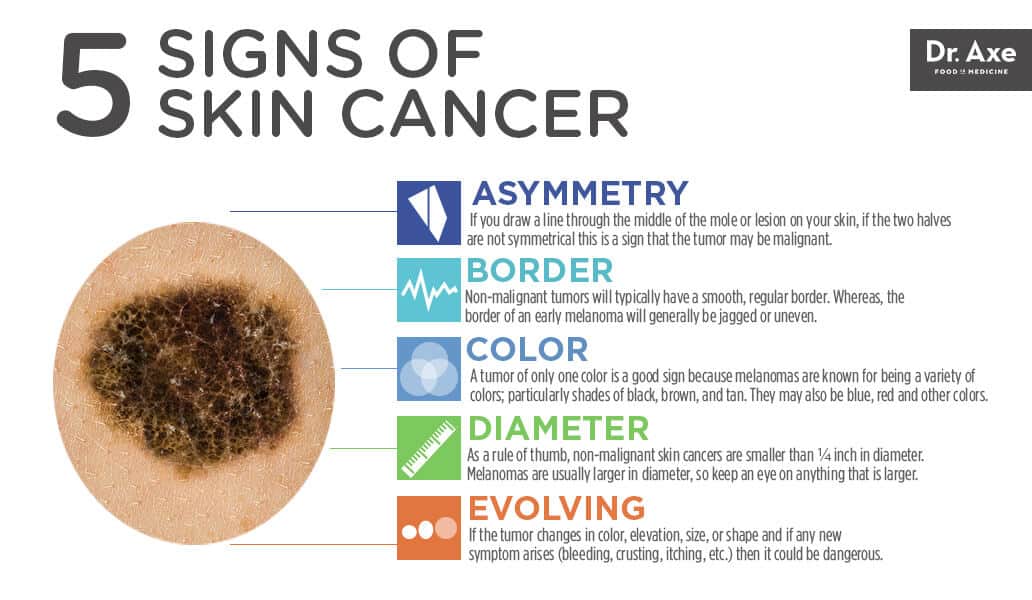
When looking for melanoma, think of the ABCD rule that tells you the signs to watch for:
  • Asymmetry—the shape of one half doesn't match the other
  • Border—edges are ragged or blurred
  • Color—uneven shades of brown, black, tan, red, white or blue

  • How is skin cancer treated?

Treatment of skin cancer is individualized and is determined by the type of skin cancer, its size and location and the patient's preference.
Standard treatments for non-melanoma skin cancer (basal cell or squamous cell carcinomas) include:
  • Mohs surgery (for high-risk non-melanoma skin cancers)—excision of cancer and some extra tissue
  • Electrodesiccation and curettage—physically scraping away the skin cancer cells followed by electrosurgery
  • Cryosurgery or freezing
  • Laser therapy
  • Drugs (chemotherapy, retinoids)

How can I help prevent skin cancer?


  • Apply sunscreen with a sun protection factor (SPF) of 15 or greater 30 minutes before sun exposure and then every few hours thereafter.
  • Select cosmetic products and contact lenses that offer UV protection.
  • Wear sunglasses with total UV protection.
  • Avoid direct sun exposure as much as possible during peak UV radiation hours between 10:00 a.m. and 3:00 p.m.
  • Perform skin self-exams regularly to become familiar with existing growths and to notice any changes or new growths.
  • Eighty percent of a person's lifetime sun exposure is acquired before age 18. As a parent, be a good role model and foster skin cancer prevention habits in your child.

Related image

Health and Beauty tips


2200 SW 16 ST Suite 224 Miami, FL 33145

Please “like” & share! Thank you!

I hope you’ve found some of my tips helpful!

FOR LIVE ACTION, FOLLOW ME ON SNAPCHAT: lizskincare 
INSTAGRAM: lizskincaremiami

BEST SKINCARE WISHES LIZ SKINCARE


Tuesday, April 11, 2017

How to treat your flaky dry skin


Flaky dry skin is super frustrating to deal with, but here are some cures I have discovered that help so far:


1. Start showering with warm water:


  •  Showering with steamy hot water may feel good, but that hot water is not a good idea for dry skin.The problem is that hot showers strip your body of its natural oil barrier, and you need that barrier to help trap moisture and keep your skin smooth and moist.

2. Wash with a soapless cleanser when you shower:


  •  Gentle soaps that are free of fragrance are the best option. 
  • Products with deodorant or antibacterial additives can be harsh on skin which could cause the dryness. 
  • Consider a cleanser that contains ceramics which are fatty molecules that make up the outer barrier of your skin, they help skin hold in moisture

3. When shaving: 

  • Shaving can irritate dry skin. When you shave unwanted hair, you are also scraping off your natural oils. The best time to shave is after you shower because hairs are softer and more pliable after bathing, making shaving way easier.
  • Always use a shaving cream or gel, and shave in the direction the hair is growing to protect your skin.
  • Make sure the razor is sharp. A bad razor blade can cause worse irritation. Change your razor blades as often as you can because it could cause the irritation. If you are using a blade you've used before, soak it in rubbing alcohol to clean it well so it won't cause things such as ingrown hairs or inflammation. 

4. Sun:

  • Sunlight is one of the main reason for dryness, wrinkles and roughness. 
  • In the winter, you could dress in layers so that the cold does not dry up or irritate your skin.
  • In the summer, wear an SPF 30 sunscreen.

5. MOISTURIZE:

  • The simplest moisturizing products can soothe dry skin. A great option is Petroleum Jelly.


Health and Beauty tips

Liz Skincare 

2200 SW 16 ST Suite 224 Miami, FL 33145

Please “like” & share! Thank you!

I hope you’ve found some of my tips helpful!

FOR LIVE ACTION, FOLLOW ME ON SNAPCHAT: lizskincare 
INSTAGRAM: lizskincaremiami

BEST SKINCARE WISHES LIZ SKINCARE


Friday, April 1, 2016

Stressing on a regular basis, can cause pigmentation issues on the skin.

I have been flooded with numerous queries lately on ”skin whitening” 

 Remember STOP stressing 
Don’t Blame it all on the Sun.

The sun is responsible for most skin hyper-pigmentation, hence the nickname “sun damage.” But don’t blame it all on the sun. Stress, hormones, diet and inflammation from any trauma can all cause skin hyperpigmentation. Melasma, for example, is almost always caused by something other than the sun.

Well what about stress? Well, there are two stress hormones: epinephrine and norepinephrine, that are both dependent on Tyrosine. When you become stressed, cortisol rises and Tyrosinase is used to produce more of these stress hormones. Because your body cannot distinguish between the stress of a life threatening emergency and the stress over a final exam, it responds in the same way regardless of the circumstance. Stressing on a regular basis, therefore, depletes your body and could lead to issues with skin hyperpigmentation (among many other unpleasant skin issues.)

How to prevent pigmentation issues on the skin!  

Always wear a sunscreen, especially during pregnancy or when you take oral contraceptives.

 Try to stay in the shade during intense sunlight, especially between 10 am and 2 pm.

 Gently cleanse skin, and use warm water to open your pores.

 Gently exfoliate and then moisturize your skin every day.

 Remember that some drugs like birth control pills and sleeping pills can cause pigmentation; the effects of these drugs should stop when you quit taking them.

At Liz Skincare we offer effective skin whitening or skin bleaching. 

Please visit our INSTAGRAM and see for your self many before and after pictures of my work. 

Friday, March 25, 2016

Simple Skincare tips for youthful looking skin

 Simple Skincare tips for youthful looking skin. A wrinkle-free, beautiful glowing skin is desired, but not achieved by all. Like anything else, our skin also demands care and attention. Though the conserving time for taking proper care of the skin is difficult in today’s busy schedule, it is not impossible. You only need to dedicate a little time to keeping your skin wrinkle free and beautiful for a longer period. Let’s have a look at ways in which you can protect your skin:
  1. 1. Minimize the skin exposure to the sun: Though sunlight is a major source of vitamin D, overexposure to the sun accelerates the skin aging process. To avoid this, wear a hat, sunglasses, scarves, etc. to keep your skin protected from sunlight. Don’t forget to apply sunscreen lotion before leaving the house to protect the areas of your skin that get exposed to the sun.
  2. Lie on your back– Develop a habit of lying on your back when you sleep, and not on your sites as this restricts the chances of skin damage.
  3. 4. Follow a proper diet: There is no alternative to developing good eating habits when it comes to health, beauty and well being. Your daily food chart should be rich in fruits and vegetables. Fish are also great for the skin, especially oily fish like Salmon. Adopt a healthy and balanced diet as your everyday routine, and your skin will thank you.
  4. 5. Get enough sleep: If you want a beautiful glowing skin, you should get adequate sleep. That is 7-8 hours of shut-eye every night. Inadequate sleep increases the secretion of the hormone cortisol, which negatively impacts the skin.
  5. Use anti-aging products: Not all anti-aging products are effective, but if you use the right products, they can help you keep your skin hydrated, fresh and youthful.


Please “like” & share! Thank you!
I hope you’ve found some of my tips helpful!
SEE THE ACTION HAPPENING FOLLOW ME ON SNAPCHAT: lizskincare


<a href="http://www.bloglovin.com/blog/14813989/?claim=t387dj2dpmt">Follow my blog with Bloglovin</a>

Image Slider